Behind Your Jacket: A Day in the Life of Ramesh, Master Embroiderer

The Hands Behind Your Jacket Have a Name
When you buy a Zoshak jacket, you'll find a small card tucked inside.
On it: a photo, a name, a signature.
Ramesh Kumar.
Master Embroiderer, Jaipur
That's not marketing. That's not a gimmick.
That's the real person who spent 8-11 hours hand-embroidering every single stitch on your jacket.
Today, I want to introduce you to him properly. Because once you know Ramesh's story, you'll never look at your jacket the same way again.
Let's step into his world. 🇮🇳✨
5:30 AM — Before the City Wakes
Ramesh wakes up before dawn in his small home in Sanganer, a historic neighborhood on the outskirts of Jaipur.
His wife, Meena, is already in the kitchen preparing chai and breakfast. Their two kids — Kavya (14) and Arjun (11) — are still asleep, their school uniforms laid out for the day.
"I like the quiet of early morning," Ramesh tells me as we sit on his rooftop, watching the sun rise over Jaipur's pink buildings.
"When I start work later, my mind is already calm. That calmness goes into every stitch."
This isn't just a job to Ramesh. It's a meditation. An art form. A legacy.
6:30 AM — Morning Ritual
After breakfast with his family, Ramesh walks to his workshop — a 10-minute stroll through narrow lanes where vendors are just starting to set up fruit carts and chai stalls.
He stops at the neighborhood temple. Offers a quick prayer.
"My grandfather taught me: Always thank the hands before you begin work. These hands," he says, holding up his calloused fingers, "are gifts. I treat them with respect."
At 38, Ramesh has been embroidering for 28 years. He started at age 10, sitting beside his grandfather, watching fingers fly across fabric.
"My grandfather could embroider with his eyes closed. He said the hands remember. After so many years, I understand what he meant."
7:00 AM — The Workshop Opens
Ramesh's workshop is a small, sunlit room attached to his home. The walls are lined with:
- Spools of embroidery thread (hundreds of colors)
- Wooden frames for stretching fabric
- Sketches and pattern references
- Photos of his family
- A framed photo of his grandfather
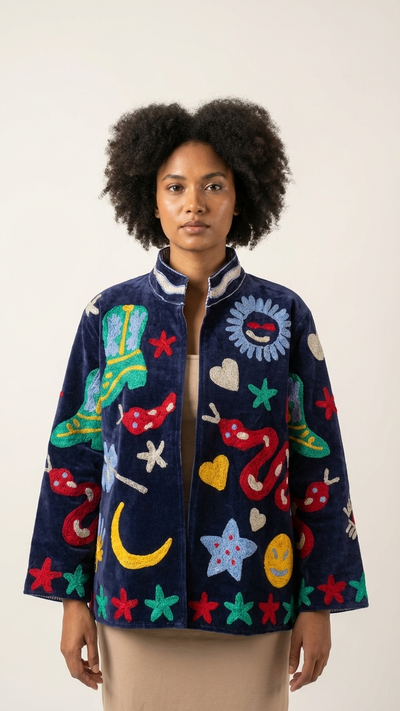
On his workbench today: three Nazar jackets in various stages of completion.
"This one," he points to navy velvet laid flat, "I started yesterday. This one I finish today. And this one ships tomorrow."
Each jacket is tracked meticulously. Quality is everything.
8:00 AM — The First Stitch
I watch as Ramesh begins work on a fresh jacket.
The design is already sketched on the fabric in water-soluble chalk — a large evil eye motif in the center back.
He threads a needle with bright yellow thread. Tests the tension. Then:
The first stitch.
His hands move in a rhythm that looks effortless but is actually the result of nearly three decades of practice.
Chain stitch. The foundation of traditional Indian embroidery.
Each loop must be:
- Perfectly sized (consistency matters)
- Evenly tensioned (too tight = fabric puckers, too loose = stitches sag)
- Precisely placed (alignment creates the pattern)
"People think embroidery is just pushing thread through fabric," Ramesh smiles. "They don't see the 10,000 hours of practice to make it look easy."
10:00 AM — Tea Break & Phone Call
Ramesh's phone buzzes. It's me — or rather, it's the Zoshak team checking in on order progress.
Unlike traditional garment factories where workers are anonymous, Ramesh has a direct relationship with Zoshak. He knows the team. They know his family. They've visited his workshop multiple times.
"Before Zoshak," he explains, "I worked through middlemen. They paid whatever they wanted. Some months I earned well, some months barely anything."
"Now? Stable income. Fair pay. And my name on every piece I make. That last part... that means everything."
After the call, his wife brings chai and homemade biscuits. They chat about their daughter's upcoming school exams. Normal family life, supported by extraordinary craft.
12:00 PM — The Intricate Part
By noon, Ramesh has completed the outer ring of the evil eye design. Now comes the detail work — the center of the eye, where multiple colors intersect.
This part is slower. More deliberate.
Red thread for the inner circle.
Blue for the middle ring.
Yellow for highlights.
Each color change requires:
- Re-threading the needle
- Securing the previous thread on the back
- Starting fresh with perfect tension
I ask him: "Do you ever get bored? Doing the same pattern?"
He laughs. "Never! Each jacket is different. The fabric has personality. The thread behaves differently based on humidity. My hands are different each day — sometimes stiff, sometimes loose."
"Plus, I think about the person who will wear this. Where will they wear it? What will make them smile when they see this stitch? I embroider with intention."
This is the part that machines can't replicate. The human intention. The consciousness embedded in craft.
1:30 PM — Lunch Break
Work pauses. Ramesh joins his family for lunch — dal, roti, sabzi, and rice prepared by his wife.
His son, Arjun, asks to try embroidering after school.
"Maybe," Ramesh says, a glint in his eye. "But first, your math homework."
I ask if he wants his children to become embroiderers.
"I want them to have choice," he says firmly. "My grandfather had no choice. I had limited choice. But Kavya wants to be a teacher. Arjun loves cricket. They can be anything."
"But if they choose this craft? I'll be the proudest father in Jaipur."
This is what fair wages enable: choice. Education. Opportunity.
3:00 PM — Back to Work
The afternoon light is perfect for detail work. Ramesh switches to the finest needle in his collection — almost impossibly thin.
Now he's adding accents. Tiny decorative stitches around the main motif that most people won't even notice.
"But you'll feel it," he insists. "Quality is in the details people don't see."
This perfectionism is why Zoshak chose to work with Ramesh and artisans like him. There are faster embroiderers. Cheaper ones. But none more dedicated to excellence.
"I sign each jacket with my name," he says, showing me the small embroidered 'RK' hidden inside the collar. "That signature is my promise: This is my best work."
5:00 PM — Quality Check
By late afternoon, the evil eye is complete. Ramesh holds the jacket up to the light, examining every inch.
He finds one stitch where the tension is slightly off. Invisible to my untrained eye.
He unpicks it. Re-does it. Perfect now.
"My grandfather used to say: If you wouldn't be proud to show this to God, don't show it to customers."
"I don't know if God cares about embroidery," he grins, "but I care. My name is on this. My reputation."
This jacket will pass two more inspections before it ships — one by Ramesh's wife (she has an eagle eye for quality) and one by the Zoshak team. But Ramesh's internal standard is highest of all.
6:30 PM — The Workshop Closes
As the sun sets, Ramesh carefully covers his unfinished work, tidies his threads, and locks the workshop.
Tomorrow he'll continue. But today's work is done.
One jacket completed.
One jacket 60% done.
One jacket just started.
This rhythm — this slow, deliberate pace — is how quality happens.
Not 100 jackets per day in a factory. Three jackets per week by one master craftsman.
7:00 PM — Evening with Family
Dinner time. The whole family gathers.
Kavya talks about her school day. Arjun shows off a new cricket move. Meena shares neighborhood gossip.
Ramesh listens, laughs, contributes. A normal evening. A normal family.
Except it's not normal in the garment industry.
Most garment workers don't get home for dinner. They're still on factory floors, working 12-14 hour shifts for less than $3/day.
Ramesh works 7-8 hours. Earns 3x the market rate. Has time for family. Dignity in his work.
This is what fair trade actually looks like.
9:00 PM — Before Bed
Before sleeping, Ramesh sketches in a small notebook. New pattern ideas. Modifications to existing designs.
"Sometimes I dream about stitches," he admits. "I'll wake up with an idea for a new technique."
I ask him what he thinks about when he embroiders.
"I think about the person wearing it. Walking down a street somewhere — New York, London, Tokyo. Feeling confident. Feeling beautiful."
"I think: Maybe that person is wearing my work right now. And they're having a good day."
"That's enough. That's everything."
The Bigger Picture: Why Ramesh's Story Matters
Ramesh isn't special because he's the only skilled artisan in India. He's special because he's one of thousands who SHOULD have their stories told, but don't.
In traditional fashion:
- Workers are anonymous
- Paid poverty wages
- Replaceable parts in machine
- No creative input
- No recognition
In the Zoshak model:
- Artisans are celebrated by name
- Paid fair wages (3x market rate)
- Creative partners
- Full recognition
- Direct relationship with brand
This isn't charity. This is justice.
Ramesh's skill, honed over 28 years, deserves recognition and fair compensation. When you buy his jacket, you're voting for a fashion industry that values human beings over profit margins.
What Your Purchase Means to Ramesh's Family
Let's get specific about impact:
Your $59 jacket purchase means:
✓ $30-35 to Ramesh and his workshop (direct artisan payment)
✓ 2-3 days of skilled work at fair hourly rate
✓ Contribution to Kavya's education (school fees, books, uniforms)
✓ Support for Arjun's cricket passion (equipment, coaching)
✓ Healthcare access for the family
✓ Dignity in Ramesh's work
✓ Pride in creating something beautiful
✓ Preservation of 500-year craft tradition
Every. Single. Purchase. Matters.
Meet More Artisans
Ramesh is one of 12 artisan partners at Zoshak. Each has a story:
Geeta (Neon Soul Edition) — Breaking tradition with bold colors
Fatima (Golden Suzani) — Leading a women's embroidery collective
Meena (Berry Suzani) — Balancing craft and motherhood
Their stories are just as rich, just as important. We'll be sharing them in upcoming posts.
How You Can Support Artisans Like Ramesh
1. Buy Directly from Artisan Brands
Brands like Zoshak, Okhai, and similar that name their makers and pay fairly.
2. Ask "Who Made This?"
Demand transparency from ALL brands you buy from.
3. Value Handmade
Understand that handmade SHOULD cost more. It's worth more.
4. Share Artisan Stories
Post about the maker when you post about your outfit. They deserve recognition.
5. Visit Jaipur
If you can, visit artisan workshops. Meet makers in person. It changes everything.
A Message from Ramesh to You
Before I left, I asked Ramesh if he wanted to say anything to people who buy his jackets.
He thought for a moment. Then:
"Thank you for seeing me. Not just the jacket, but me — the person who made it."
"In my grandfather's time, artisans were invisible. Now, because of people like you choosing handmade, my children know their father's work is valued."
"When you wear the jacket, I hope you feel the love I put into every stitch. Because it's there. In every single one."
"Wear it well. Wear it proudly. And know that in Jaipur, a family is grateful."
Your Jacket is Waiting
Every Zoshak jacket comes with:
- The artisan's name and photo
- Their signature
- A QR code linking to their video story
- Fair trade certification
Because you deserve to know who made your clothes.
TAGS: #MeetTheMaker #ArtisanStory #FairTrade #HandmadeInIndia #JaipurArtisan #BehindTheSeams #SlowFashion #EthicalFashion #KnowYourMaker