Indian Textile Traditions Every Fashion Lover Should Know

India is home to one of the most extraordinary textile cultures on earth. For thousands of years, its artisans have developed techniques of weaving, dyeing, printing, and embroidery that remain unmatched in their complexity, beauty, and variety. If you love fashion — truly love it, as craft and culture rather than trend — these are the traditions you need to know.
1. Suzani Embroidery — The Silk Road in Thread
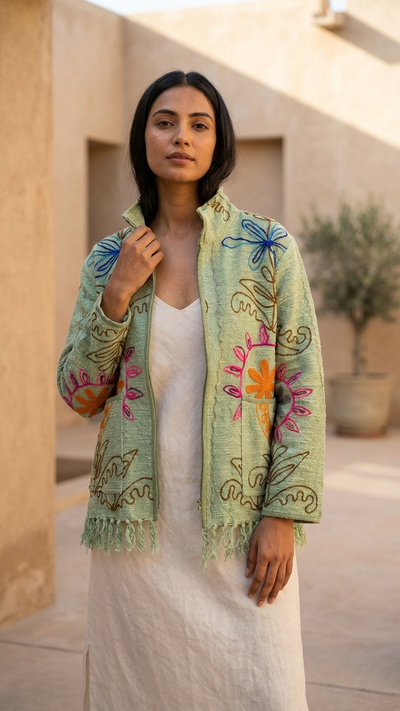
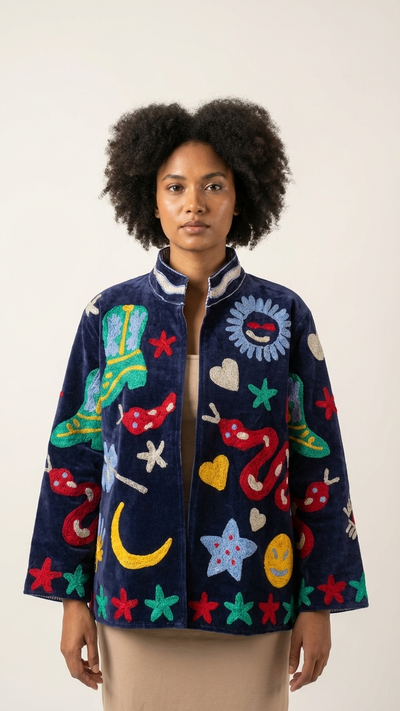
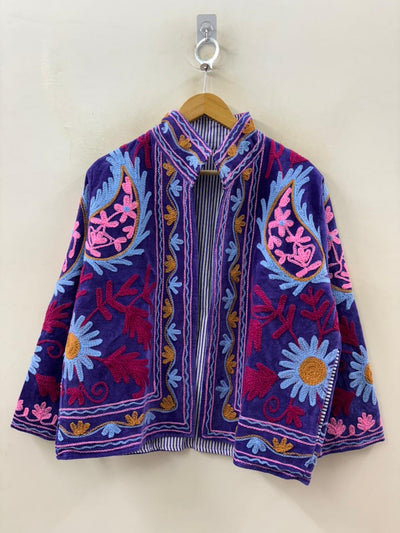
Suzani embroidery originated in Central Asia — in Uzbekistan, Tajikistan, and the regions along the ancient Silk Road — and came to India through the cultural exchange of the Mughal Empire. Today, Jaipur’s artisans practise a form of Suzani chain-stitch embroidery that is uniquely Indian in its colour and sensibility while remaining rooted in the ancient Central Asian tradition.
The motifs — pomegranates, poppies, medallion rosettes, garden vines — are worked in dense chain stitch onto velvet or cotton, creating pieces of extraordinary richness and depth. A single Suzani jacket can take days to complete.
2. Hand Block Printing — The Art of the Wooden Stamp
Block printing is one of Rajasthan’s most celebrated crafts. Artisans in Jaipur, Sanganer, and Bagru carve intricate designs into wooden blocks, then press them by hand onto fabric in repeating patterns. The result is a textile that is both precise and alive — the slight variations of the human hand visible in every impression.
Block printing on velvet, as practised by Zoshak’s artisans, is particularly challenging — the pile of the velvet requires special technique to achieve the rich, saturated prints that make our jackets so distinctive.
3. Ikat Weaving — The Resist-Dyed Textile
Ikat is a weaving technique in which the threads are dyed before weaving, creating patterns that appear to bleed at the edges — a characteristic blurriness that is the hallmark of genuine ikat. India produces ikat in several regional styles, from the fine silk ikats of Pochampally in Telangana to the bold cotton ikats of Odisha.
The technique requires extraordinary planning — the weaver must calculate exactly where each dyed section of thread will fall in the finished cloth before a single thread is woven.
4. Dabu Printing — The Mud Resist Tradition
Dabu is a form of resist printing unique to Rajasthan, in which a paste made from clay, lime, and gum is applied to fabric before dyeing. The paste resists the dye, leaving the pattern in the original colour of the cloth. After dyeing, the paste is washed away to reveal the design.
Dabu printing produces textiles with a distinctive earthy, organic quality — the resist paste never perfectly replicates the same pattern twice, giving each piece a unique character.
5. Chikankari Embroidery — The White-on-White Art of Lucknow
Chikankari is a form of hand embroidery developed in Lucknow, in the state of Uttar Pradesh, under Mughal patronage. It is worked in white thread on white or pastel fabric, creating delicate, shadow-like patterns of extraordinary refinement. Chikankari uses over 30 different stitches, each with its own name and character.
6. Kantha Embroidery — The Running Stitch of Bengal
Kantha is a form of embroidery from West Bengal and Bangladesh, traditionally worked by women using a simple running stitch to create intricate patterns on layers of old sari cloth. The word kantha means “throat” or “rag” in Sanskrit — a reminder that this was originally a craft of repurposing and reuse, long before sustainability became a fashion buzzword.
Why These Traditions Matter
Each of these traditions represents centuries of accumulated knowledge — knowledge that lives in the hands of artisans, passed from generation to generation. When you buy a piece that uses one of these techniques, you are not just buying a garment. You are participating in the preservation of a living cultural heritage.
At Zoshak, we work with Suzani embroidery and hand block printing — two of Jaipur’s most celebrated traditions. Every piece we make is a small act of preservation, as well as a beautiful thing to wear.