The Art of Suzani Embroidery — A Journey from the Silk Road to Jaipur

There is a kind of embroidery that carries the memory of entire civilisations within its stitches. Suzani embroidery — dense, vivid, and unmistakably alive — is one of them. At Zoshak, it is the heartbeat of everything we make.
What Is Suzani Embroidery?
The word suzani comes from the Persian suzan, meaning needle. It refers to a tradition of hand-embroidered textiles that flourished across Central Asia — in Uzbekistan, Tajikistan, Kazakhstan, and beyond — for centuries. Traditionally, Suzani pieces were made by brides and their families as part of a dowry, stitched over months or years before a wedding, then displayed in the marital home as a symbol of love, protection, and abundance.
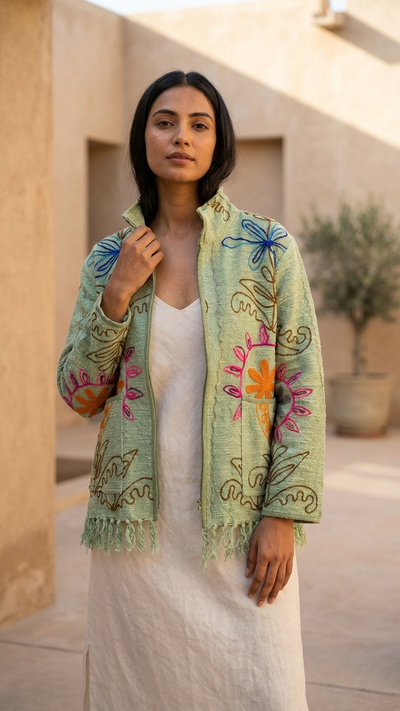
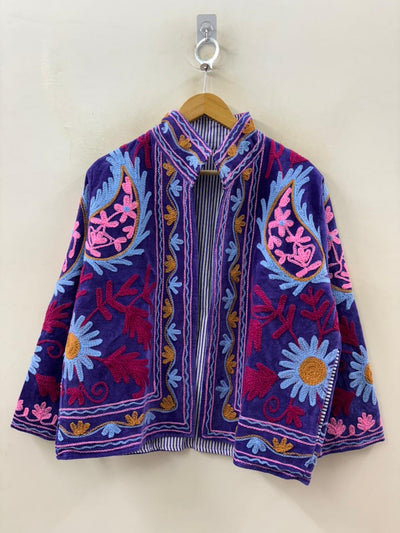
The embroidery is worked in silk or cotton thread onto a cotton or silk base, using a chain stitch or a flat satin stitch. The motifs are bold and symbolic: pomegranates for fertility, poppies for beauty, medallion rosettes for the sun, vines and leaves for the garden of paradise.
The Motifs and Their Meanings
Every motif in Suzani embroidery carries meaning rooted in the ancient cultures of the Silk Road:
- Pomegranates — Fertility, abundance, and the sweetness of life. One of the most beloved motifs across Central Asian and Persian textile traditions.
- Poppies — Beauty, remembrance, and the fleeting nature of things. The poppy fields of Central Asia have inspired artists and poets for millennia.
- Medallion rosettes — The sun, the cosmos, and divine protection. These circular motifs are found across Islamic art, from tilework to carpets to embroidery.
- Vines and leaves — The garden of paradise, known in Persian as the bagh. The garden is one of the most enduring symbols in Islamic art — a place of beauty, order, and spiritual abundance.
How Suzani Came to Jaipur
India and Central Asia have been in conversation for centuries — through trade, migration, and the great cultural exchange of the Mughal Empire. The Mughal emperors, themselves of Central Asian origin, brought Persian and Uzbek artistic traditions to the Indian subcontinent, where they merged with local craft to create something entirely new.
Jaipur, the Pink City of Rajasthan, became one of the great centres of Indian craft — a city of artisans, dyers, block printers, and embroiderers. It is here that the Suzani tradition found a new home, adapted by local craftswomen who brought their own sensibility to the ancient motifs.
How Zoshak Artisans Work
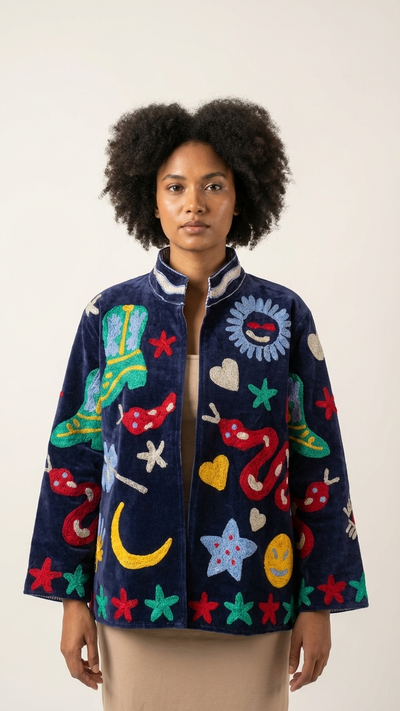
At Zoshak, every Suzani jacket begins with a length of rich cotton velvet — deep midnight black, burnt sienna, cobalt blue, dusty rose. The artisan traces the design onto the fabric by hand, then begins the slow, meditative work of chain-stitch embroidery: a loop of thread pulled through the fabric, one stitch at a time, building up the motif from the inside out.
A single jacket can take days to complete. The embroidery is dense — covering the shoulders, the back, the collar, the cuffs — so that the finished piece feels less like a garment and more like a painting you can wear.
No two jackets are identical. The hand that makes each one leaves its own trace in the work.
How to Style a Suzani Embroidered Velvet Jacket
The beauty of a Suzani jacket is that it does the work for you. Keep everything else simple:
- Wear it open over a white tee and straight-leg jeans for an effortless everyday look.
- Layer it over a slip dress for evening — the velvet and embroidery elevate any outfit instantly.
- Belt it at the waist to define the silhouette and turn it into a statement coat.
- Pair it with wide-leg trousers and a simple top for a maximalist, fashion-forward look.
A Suzani jacket is not a trend. It is a piece of living craft — something to wear, to love, and to pass on.