The Gardens of Samarkand — The Inspiration Behind Zoshak’s Designs

There is a city at the heart of the ancient Silk Road that has been called, for two thousand years, one of the most beautiful places on earth. Its name is Samarkand. And its gardens — real and imagined, historical and mythological — are the soul of everything Zoshak makes.
Samarkand and the Silk Road
Samarkand sits in what is now Uzbekistan, in the fertile Zerafshan valley between the mountains of Central Asia. For millennia it was one of the great crossroads of the ancient world — a city where merchants, scholars, artists, and travellers from China, India, Persia, and the Arab world met, traded, and exchanged ideas.
The Silk Road was not just a trade route for silk. It was a highway for culture — for music, mathematics, astronomy, architecture, and art. And at the centre of it all was Samarkand, a city of turquoise domes, tiled minarets, and gardens that were spoken of in poetry across the known world.
The Garden as Symbol — Paradise, Abundance, Protection
In the Persian and Islamic traditions that shaped Samarkand’s culture, the garden — bagh in Persian and Urdu — is one of the most powerful symbols in existence. The word paradise itself comes from the Old Persian pairidaeza, meaning a walled garden.
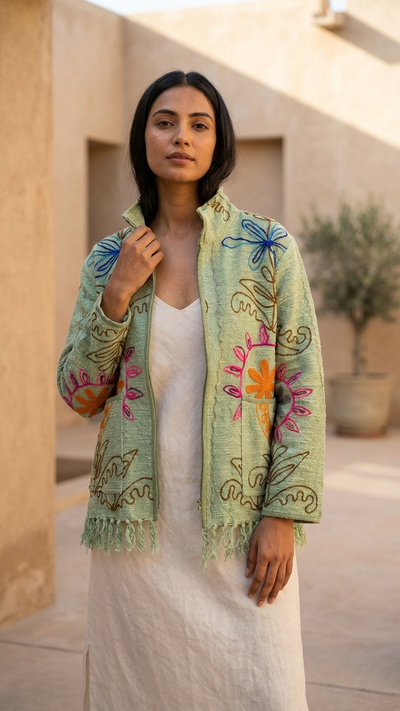
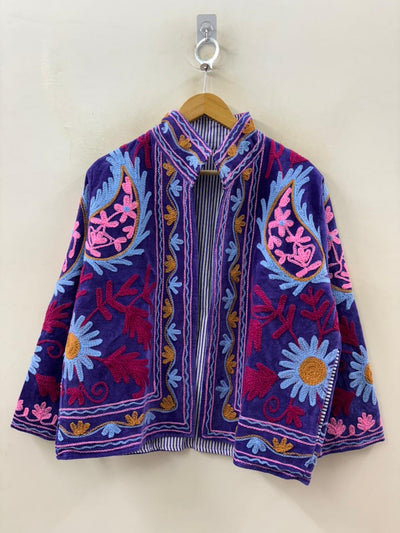
The garden represents the divine order imposed on the wilderness of the world — a place of beauty, abundance, and protection. In Islamic art and architecture, the garden appears everywhere: in the geometric tile patterns of mosques, in the carpet designs of Central Asia, in the miniature paintings of the Mughal court, and in the embroidery of Suzani textiles.
The motifs of the garden — pomegranates, poppies, vines, medallion rosettes, birds in flowering trees — are not merely decorative. They are a visual language, a way of speaking about the world and our place in it.
How These Motifs Translate into Embroidery
When a Suzani embroiderer in Jaipur picks up her needle and thread, she is working within a tradition that stretches back through the Mughal Empire to the courts of Samarkand and Bukhara. The motifs she stitches — the poppy, the pomegranate, the medallion, the vine — are the same motifs that appeared on the textiles of the Silk Road a thousand years ago.
But she is not copying. She is interpreting. Each artisan brings her own hand, her own sense of colour and proportion, her own small variations to the ancient patterns. The tradition lives because it is alive — because it is always being remade by the people who carry it.
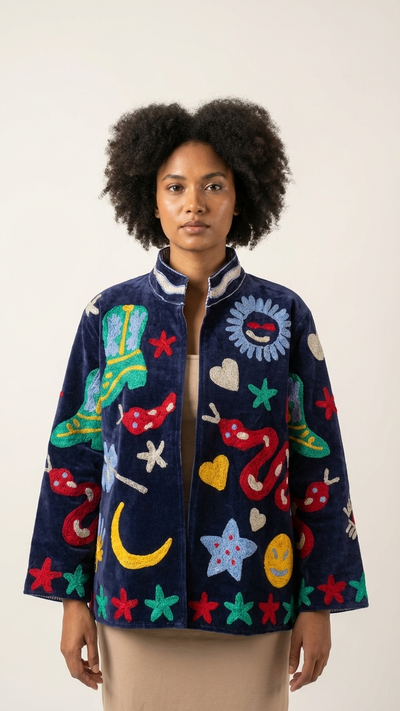
At Zoshak, we work closely with our artisans to develop designs that honour this tradition while speaking to a contemporary sensibility. The colours are our own — dusty rose, midnight black, burnt sienna, cobalt blue — chosen to work with the embroidery and with the velvet. But the motifs are ancient. They carry the memory of Samarkand in every stitch.
The Zoshak Design Process
Every Zoshak jacket begins with a conversation — between us and our artisans, between the tradition and the present moment. We discuss the base colour, the embroidery palette, the density of the stitching, the placement of the motifs. The artisan sketches the design onto the fabric by hand, then begins the slow work of bringing it to life.
There are no digital files, no CAD drawings, no automated processes. The design exists first in the mind of the artisan, then in the fabric, then in the world. It is a process that cannot be rushed — and we would not want it to be.
Meet the Artisans Behind the Work
The craftswomen who make Zoshak’s Suzani jackets are based in Jaipur, Rajasthan — a city that has been a centre of Indian craft for centuries. Many of them learned their skills from their mothers and grandmothers. The chain stitch they use is the same stitch that has been used in this region for generations.
They work in small workshops, often from home, fitting the embroidery around the rhythms of family life. Each jacket represents many hours of their time and attention — hours that are reflected in the density of the embroidery, the precision of the stitching, the life that seems to pulse through the finished piece.
When you wear a Zoshak jacket, you carry a little of Samarkand with you — and a little of Jaipur, and a little of the woman who made it. That is the story in every stitch.