What is Hand Block Printing? The Ancient Rajasthani Craft Behind Your Jacket

When you hold a Zoshak block-printed jacket, you are holding something that took centuries to perfect. Hand block printing is one of India’s oldest and most celebrated textile traditions — a craft that has survived industrialisation, globalisation, and the rise of digital printing because nothing a machine makes can replicate what a human hand does.
A 500-Year History
Block printing in Rajasthan dates back at least 500 years, though some historians trace its roots even further — to the ancient trade routes that connected India to Persia, Central Asia, and the Arab world. The city of Jaipur became one of the great centres of the craft, alongside Bagru and Sanganer — towns just outside the city where entire communities of artisans, known as Chippa, have practised block printing for generations.
These communities developed their own distinct styles, dyes, and motifs — from the indigo and rust of Bagru’s natural dye tradition to the fine floral prints of Sanganer. Today, Jaipur’s block-printing artisans are recognised worldwide as masters of their craft.
How Carved Wooden Blocks Are Made
Every block-printed textile begins with a block — a piece of teak or sheesham wood, carved by hand into a precise pattern. The carving process alone can take days for a complex design. The craftsman works with small chisels and gouges, cutting away the wood to leave the pattern in relief — like a stamp.
A single design might require multiple blocks — one for the main motif, one for the outline, one for a secondary colour. Each block must align perfectly with the others when printed, requiring extraordinary skill and a steady hand.
The Printing Process
The printing itself is a rhythmic, meditative process. The fabric is stretched flat on a long padded table. The artisan dips the block into a tray of dye or pigment, taps it lightly to remove excess, then presses it firmly onto the fabric — applying even pressure across the entire surface of the block before lifting it cleanly away.
Then the block moves along the fabric, pressed again and again in a repeating pattern. The artisan’s eye and hand guide the spacing and alignment — there are no mechanical guides, no digital registration marks. Just experience, rhythm, and craft.
After printing, the fabric is dried in the sun, then washed and finished.
Why No Two Pieces Are Identical
This is the beautiful truth of hand block printing: because every impression is made by a human hand, no two pieces are ever exactly the same. The pressure varies slightly. The dye absorbs differently. The block leaves its own trace — a ghost of the craftsman’s touch — in every print.
These variations are not flaws. They are the signature of the hand. They are what makes a block-printed piece alive in a way that machine-printed fabric never can be.
How Zoshak Uses Block Printing on Velvet and Cotton
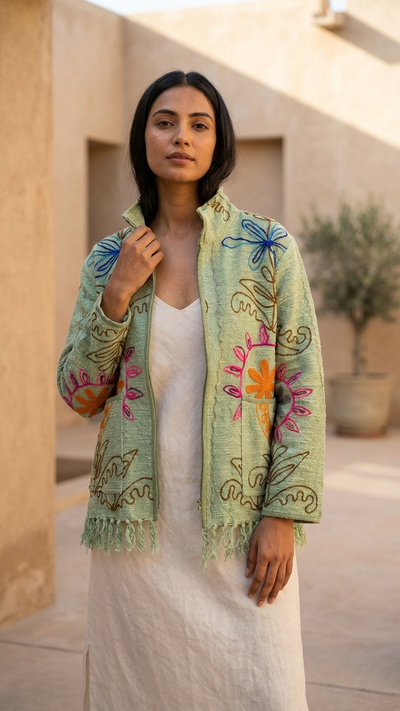
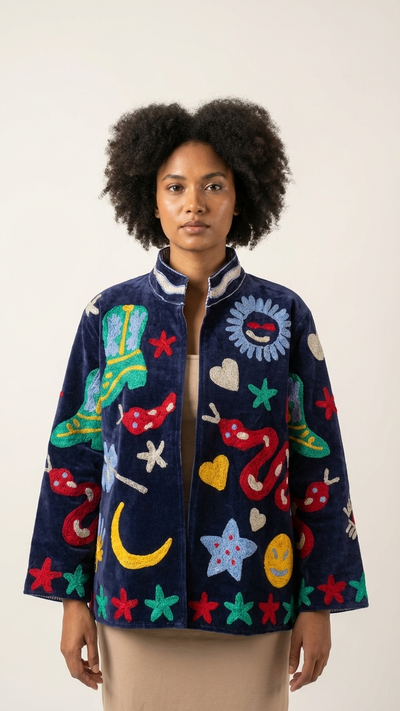
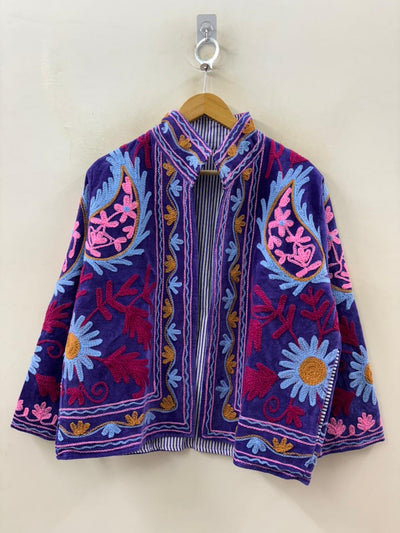
Printing on velvet is significantly more challenging than printing on flat cotton — the pile of the velvet absorbs the dye differently, and the surface requires more careful handling. Our artisans in Jaipur have developed techniques specific to velvet, achieving the rich, saturated prints you see in our jackets.
On cotton, we use a quilted base that gives the jacket structure and warmth while holding the print beautifully. The result is a jacket that is both a wearable garment and a piece of textile art.
Every block-printed Zoshak jacket is made in small batches. When a colourway sells out, it is gone — because the artisans move on to the next design, the next block, the next story.