Why Velvet? The Fabric Rajasthan Has Loved for 400 Years

There is a moment — maybe you have felt it — when you run your palm across a piece of velvet and something shifts. The fabric gives back. It moves toward your hand rather than away from it. It holds warmth without trapping it. It catches light at one angle and swallows it at another.
People have been chasing that feeling for a very long time.
In the royal courts of medieval Persia, velvet was worth its weight in saffron. Mughal emperors draped their durbar halls in it. European traders smuggled bolts of it across mountain passes. And in Rajasthan — specifically in the narrow gullies of Jaipur's old city, where dyers and weavers and embroiderers have lived side by side for centuries — velvet became the canvas for something extraordinary.
At Zoshak, we work with velvet not because it is luxurious — though it is — but because of what it allows a craftsperson to do. This is the story of that fabric, and why, four hundred years after Rajasthani artisans first touched it, velvet still refuses to be ordinary.
What Velvet Actually Is (Most People Don't Know)
Velvet is not a fibre. It is a construction — a way of weaving that creates a dense, upright pile by cutting loops of thread close to the surface. The word comes from the Old French velu, meaning shaggy or tufted. The technique almost certainly arrived in South Asia via Persia and Central Asia, traveling the same trade routes as silk, lapis lazuli, and the art of suzani embroidery.
What makes velvet distinct — and difficult — is that the pile sits vertically. Each individual thread is essentially standing on end. This is why velvet feels so alive under your fingers. Run your hand one way: the pile lays flat, the fabric darkens, it drinks the light. Run your hand the other way: the pile lifts, the surface brightens, it gives the light back. Textile artists call this "shading" or "nap direction." Tailors in Jaipur call it something more poetic: roshni aur chhaya. Light and shadow.
This quality — the velvet's ability to hold two different moods in the same piece of cloth — is exactly what makes it the perfect partner for embroidery.
Why Rajasthan and Velvet Were Made for Each Other
The embroidery traditions of Rajasthan are built on contrast. Bright thread against dark ground. Geometric structure against organic motifs. The patient, repetitive act of hand-stitching against the wildness of what gets made. Velvet intensifies every one of these contrasts.
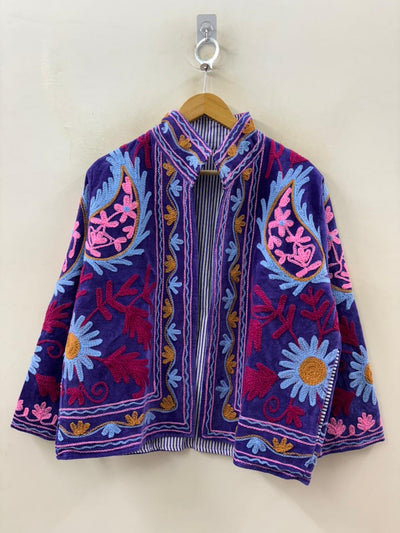
When you lay a gold zari thread across plain cotton, it catches the eye. When you lay that same thread across deep indigo velvet, it ignites. The pile creates micro-shadows around each stitch that make the embroidery look almost three-dimensional — as if the motifs are hovering just above the surface of the fabric rather than sitting flush with it.
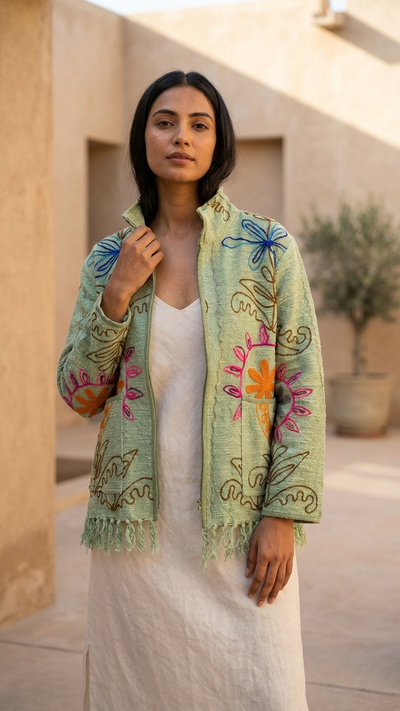
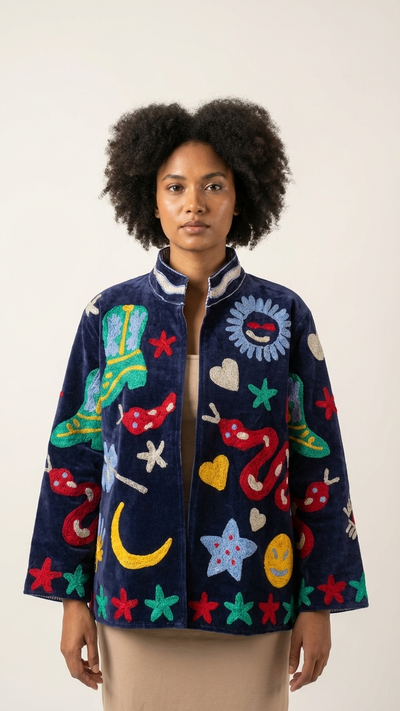
This is not a subtle difference. Hold a Zoshak jacket in natural light and tilt it slowly. You will see the suzani flowers — the pomegranates, the vines, the eye motifs — shift and breathe as the nap catches different angles of light. No photograph fully captures it. No fast fashion textile can replicate it. It requires a fabric with a living surface, and a hand that knows where each stitch must land.
The Artisan's Relationship with Velvet
Working on velvet is harder than working on most fabrics. The pile compresses under a hoop, so the embroiderer must re-lift it with a needle after each session. The nap direction affects how a stitch sits, so experienced artisans rotate their work constantly, reading the fabric the way a musician reads a score. A stitch placed "against the grain" of the pile will look different from one placed "with" it — both can be intentional, both require knowledge.
Meena, one of the embroiderers whose work appears in the Zoshak Gulbadan collection, has been working with velvet for over twenty years. She describes it as "thoda zidd wali" — a little stubborn. "Cotton does what you tell it," she says. "Velvet has opinions." She means it as a compliment. The fabric's resistance is part of what makes the finished piece feel earned.
The women in the workshops we source from typically spend between six and fourteen days on a single jacket panel, depending on the density of the embroidery. During that time, they will press the pile back into place hundreds of times. The velvet's memory — its tendency to return to its upright position — means the finished jacket still looks freshly made years after purchase. Velvet does not go limp. It does not lose its hand. It ages into itself.
Suzani on Velvet: A 500-Year Conversation
The word suzani comes from the Persian suzan, meaning needle. Suzani embroidery originated in Central Asia — in the bazaars of Samarkand and Bukhara — where women would embroider large ceremonial cloths as part of a bride's dowry. These cloths were collaborative works, made over months or years by a girl and the women of her family, filled with symbols of fertility, protection, and abundance.
When suzani motifs arrived in Rajasthan through trade and migration, local artisans absorbed them into their own vocabulary. The pomegranate — symbol of prosperity — stayed. The sun medallions stayed. The dense floral vines stayed. But Rajasthani hands added their own geometry, their own colour sense, their own spiritual symbols. The nazar — the protective eye — found its way into the patterns alongside the older Central Asian motifs.
Pairing suzani embroidery with velvet was a natural evolution. The Central Asian tradition had always favoured rich, textured grounds. Velvet, once accessible in Rajasthan's markets, became the prestige choice for this kind of work — a fabric whose own visual complexity could meet the complexity of the embroidery without being overwhelmed by it.
A Zoshak velvet jacket is, in this sense, a record of several centuries of artistic exchange. Jaipur's streets, Persia's courts, Central Asia's nomadic textile traditions — all of it compressed into a garment you can wear on a Tuesday evening in Berlin or London or Mumbai.
Why Velvet Fell Out of Fashion — and Why That Is Changing
For much of the late 20th century, velvet disappeared from everyday fashion. Fast fashion couldn't handle it — velvet is demanding to cut, demanding to sew, and impossible to produce in the race-to-the-bottom economics of mass manufacturing. A fabric that requires skill to work with is, by definition, a fabric that resists commodification.
What is happening now in fashion is a quiet correction. Buyers in Europe and the UK are increasingly rejecting the throwaway cycle — the trend piece worn twice and discarded, the polyester that sheds microplastics into the water supply, the jacket that looks identical to seventeen others on the same rail. They are looking for garments with a point of view. With history. With evidence that a human being made a series of decisions in the making of it.
Velvet, with its visible, tactile, ever-shifting surface, is impossible to mass produce convincingly. You can make a passable imitation of a printed cotton. You cannot make a passable imitation of hand-embroidered velvet. The care shows. The skill shows. The hours show.
This is exactly what our customers in Germany, the Netherlands, and the UK tell us when they write after receiving their orders. They hold the jacket. They run a hand across the embroidery. They tilt it in the light. And then they write to say something they did not expect to feel: that it seems alive.
Caring for a Velvet Jacket (The Right Way)
Velvet is forgiving in the ways that matter and demanding in the ways that are easy to manage. A few things worth knowing:
Store it hanging, never folded. Compressed velvet pile takes time to recover. A padded hanger, in a breathable garment bag, is ideal. If you need to fold it for travel, fold embroidery-side inward and re-hang as soon as possible.
Brush, don't rub. For surface dust or light marks, use a soft velvet brush or a clean, dry cloth, always moving with the pile direction. Rubbing against the nap will mat the fibres and dull the surface.
Steam, don't iron. If the pile gets compressed — from a bag, from being sat on — hold a garment steamer a few centimetres above the surface and let the steam lift the fibres. Do not press an iron directly onto velvet. Ever.
Spot clean embroidery gently. The embroidery threads on Zoshak jackets are wool and silk blends. For small marks, a damp cloth with a drop of mild soap, dabbed (not rubbed) onto the affected area, is sufficient. The jacket itself should be dry cleaned when necessary.
Looked after this way, a velvet jacket does not wear out. It wears in. The pile develops a patina — a subtle record of the life lived in it. Some of our customers tell us their jackets look better after two years than the day they arrived. We believe them.
The Fabric That Earns Its Place
There is a particular kind of possession that grows more valuable the longer you keep it. Not because the material appreciates in price — though hand-embroidered textiles often do — but because the relationship between you and the object deepens. You know its moods. You know which light makes the embroidery glow and which angle shows the nap at its richest. You remember where you wore it. You notice the artisan's hand in it more clearly as time passes, not less.
Velvet, more than almost any other fabric, rewards this kind of attention.
We make jackets at Zoshak because we believe that what you wear should have a story worth knowing. The velvet we use comes from mills that have supplied Jaipur's artisans for generations. The embroidery on it was placed by hand, stitch by deliberate stitch, by women who learned the craft from their mothers and will teach it to their daughters. The motifs carry symbolic weight that predates most of the countries that will receive the jackets.
That is a lot to carry in a garment. But velvet — stubborn, opinionated, alive with light — seems built for exactly this kind of weight.