The Women Behind Every Stitch — Inside a Jaipur Suzani Family

How three generations of embroiderers in Rajasthan are keeping a 500-year-old craft alive — one jacket at a time.
In a narrow lane behind Sanganer's dye district, Meena Devi has been threading needles since she was nine years old. Today, at 54, her fingers move with a precision that no machine has yet replicated — looping, pulling, knotting — each stitch a quiet act of memory.
Suzani embroidery, originating along the ancient Silk Road, found its way into Rajasthan centuries ago. The word itself means "needlework" in Persian. What Meena and her family produce isn't just fabric — it's a living archive of pattern, colour, and story passed down through women who never needed to write it down.
 — artisan at work, close shot of hands] Caption: Meena Devi, master embroiderer, Sanganer — working on a Suzani jacket for Zoshak
Why handmade cannot be hurried
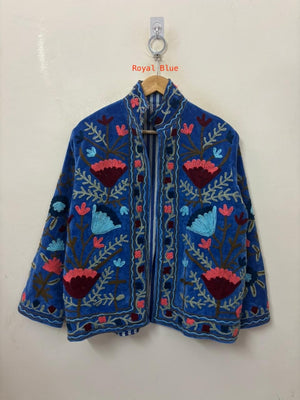
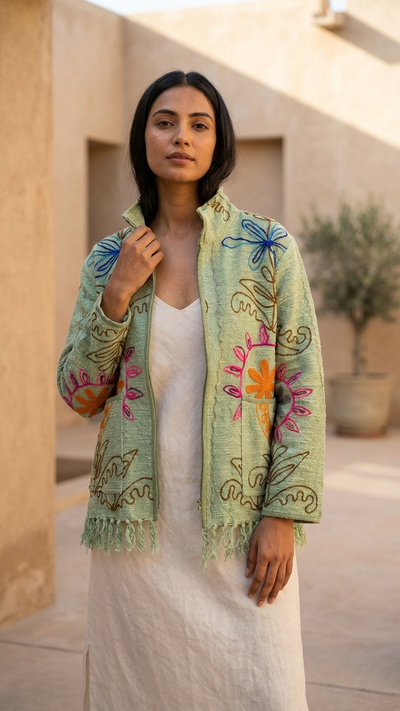
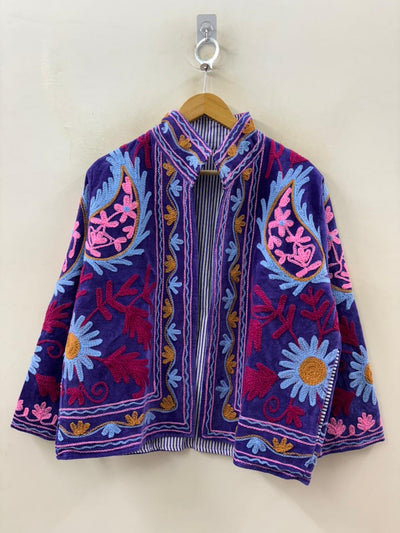
A single Zoshak jacket takes between 18 and 25 days to complete. There are no shortcuts, no speed settings. The thread is hand-dyed. The backing fabric is cut individually. The motifs — paisleys, florals, geometric medallions — are drawn freehand directly onto the cloth before the needle ever touches it.

This is what fast fashion cannot replicate: not the pattern itself, but the variation in it. No two Zoshak jackets are identical. The slight asymmetry in a petal, the tension of one stitch versus another — these are not imperfections. They are signatures.
Each jacket that leaves Jaipur has been touched by the same hands that learned this craft from a mother, who learned it from her mother before that. There is no factory floor. There is no production line. There is a woman, a needle, a thread, and a tradition older than most countries.
"My mother taught me these patterns. Her mother taught her. When I embroider, I feel all of them in the room with me." — Meena Devi, Artisan Partner, Zoshak
The economics of slow fashion
Here is something the fast fashion industry does not want you to think about: if a jacket costs $12 to make, someone, somewhere, is being paid almost nothing.
At Zoshak, our jackets take 18–25 days of skilled labour. The women who make them are not factory workers — they are master craftspeople with decades of training. We price honestly so they can be paid honestly.
Every artisan family we work with receives payment before shipment — not after. They set their timelines. They choose their patterns. We are the middlemen in the best possible sense: connecting craft to customer without diluting either.
When you pay $59 for a Zoshak jacket, here is roughly where that money goes — materials, fair artisan wages, packaging, and worldwide shipping. There is no investor margin being extracted. There is no fast fashion markup hiding a ₹200 cost.
What the Nazar means
Every Zoshak jacket carries the Nazar — the evil eye motif that has been woven into Rajasthani craft for centuries. It is not decoration. It is protection, intention, and identity stitched into the fabric itself.
The artisans who embroider the Nazar do not think of it as a design choice. They think of it as something they are passing forward — to you, to whoever sees you wearing it, to whoever asks where you got it.
That question — "where did you get that?" — is the beginning of a story we hope you'll tell.
Fair trade, not charity
We want to be clear about something: we do not use the word "charity" to describe what we do. Charity implies a power imbalance — a giver and a receiver. That is not the relationship we have with our artisan families.
Meena Devi is a skilled professional. Her time and craft are worth more than most people in this industry pay for them. We simply price honestly, so she can be paid honestly. That is not charity. That is basic decency.
The 12 artisan families we work with in Jaipur's old city are our partners, not our suppliers. They have creative input. They have say over working conditions. They are not anonymous.
If you are reading this wearing a Zoshak jacket, Meena's hands shaped what you are wearing. We think that is worth knowing.
If you are not yet wearing one — you can find the full collection here.